
|
|
|


Short Biographies / Self-Descriptions
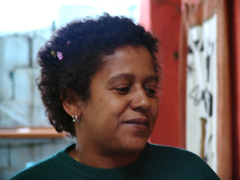 Rosangela Araujo “Janja”, is a
historian, and she started to practice capoeira in the early 80s in
Salvador with João Grande, Moraes and Cobrinha as her masters.
Since 1994, she lives in São Paulo, where she founded Nzinga
Institute of Studies of Capoeira Angola and educational traditions
of the Bantu, an NGO aiming not only for preservation of the foundations
and traditions of capoeira angola, but also fighting against racism
and sexism. Janja organizes lectures and seminars about these topics
in Brasil and abroad. At the University of São Paulo she presented
a dissertation and a habilitation about capoeira angola. Besides that
she coordinates several projects that support self-affirmative acts
of young black people who want to enter and go through an academic
education.
Rosangela Araujo “Janja”, is a
historian, and she started to practice capoeira in the early 80s in
Salvador with João Grande, Moraes and Cobrinha as her masters.
Since 1994, she lives in São Paulo, where she founded Nzinga
Institute of Studies of Capoeira Angola and educational traditions
of the Bantu, an NGO aiming not only for preservation of the foundations
and traditions of capoeira angola, but also fighting against racism
and sexism. Janja organizes lectures and seminars about these topics
in Brasil and abroad. At the University of São Paulo she presented
a dissertation and a habilitation about capoeira angola. Besides that
she coordinates several projects that support self-affirmative acts
of young black people who want to enter and go through an academic
education.
 Paula Cristina da Silva Barreto “Paulinha”, started
to practice capoeira in the early 80s in the Group Capoeira Angola
do Pelourinho G-CAP in Salvador / Bahia. She received the title of
contramestra in the early 90s. In 1998, she moved to São Paulo
for 4 years and took part in the process of structuring the capoeira
angola group Nzinga. During this period she supported the organisation
of many activities and events of the group. Living in Salvador again
since 2002, she has continued to support these activities and helped
to organize a Nzinga group there. During all the years she`s been practicing
capoeira, she remained in a constant dialogue with other capoeira angola
groups and took part in many events in- and outside Brasil. Being a
Sociologist, she is doing research about racism, youth culture, academic
doctrine, identity, and black culture, and she teaches for the Federal
University of Bahia. She has published several articles and essays
about these topics and about capoeira itself.
Paula Cristina da Silva Barreto “Paulinha”, started
to practice capoeira in the early 80s in the Group Capoeira Angola
do Pelourinho G-CAP in Salvador / Bahia. She received the title of
contramestra in the early 90s. In 1998, she moved to São Paulo
for 4 years and took part in the process of structuring the capoeira
angola group Nzinga. During this period she supported the organisation
of many activities and events of the group. Living in Salvador again
since 2002, she has continued to support these activities and helped
to organize a Nzinga group there. During all the years she`s been practicing
capoeira, she remained in a constant dialogue with other capoeira angola
groups and took part in many events in- and outside Brasil. Being a
Sociologist, she is doing research about racism, youth culture, academic
doctrine, identity, and black culture, and she teaches for the Federal
University of Bahia. She has published several articles and essays
about these topics and about capoeira itself.
 Cristina Nascimento“Cris”, started
to practice capoeira in 1993 at the age of 28. After 7 month in G-CAP
Rio de Janeiro with Mestre Neco, she started to train with mestre Emanuel,
whose oldest student she is today. She took part in the foundation
of his group Ypiranga de Pastinha. In december 2003 she recieved the
title of contramestra and is presently teaching capoeira in the space
of the group Ypiranga de Pastinha in the city centre of Rio de Janeiro.
Cristina Nascimento“Cris”, started
to practice capoeira in 1993 at the age of 28. After 7 month in G-CAP
Rio de Janeiro with Mestre Neco, she started to train with mestre Emanuel,
whose oldest student she is today. She took part in the foundation
of his group Ypiranga de Pastinha. In december 2003 she recieved the
title of contramestra and is presently teaching capoeira in the space
of the group Ypiranga de Pastinha in the city centre of Rio de Janeiro.
 Maria Eugenia Poggi “Gegê”, started
capoeira angola under the guidance of mestre Cobra Mansa in 1995 when
she moved to Washington DC, USA. She was present when the International
Capoeira Angola Foudation FICA was founded in 1996 and since then she
has participated in all the internationl conferences organized by FICA.
Gegê also helped with the organization of the first women's encounter
in the US (WDC) in 1997 titled “Women in Movement” as well
with on five other women's events organized by FICA (Philadelphia ´99,
Oakland ´01, Seattle ´02, Seattle ´03 and Seattle ´05).
At the last three conferences she also led movement workshops. In March
2003 Gegê was invited to participate and teach at the "Angoleiras
Encounter" in Rio and in July of the same year she received the
title of treinel of Capoeira Angola during FICA's international encounter
in Belo Horizonte, Brazil. At the end of 2003 Gegê moved to Lima,
Peru where she also led workshops and at the beginning of 2005 she
went back to Washington DC where she is one of the leaders responsible
for the FICA group in this city.
Maria Eugenia Poggi “Gegê”, started
capoeira angola under the guidance of mestre Cobra Mansa in 1995 when
she moved to Washington DC, USA. She was present when the International
Capoeira Angola Foudation FICA was founded in 1996 and since then she
has participated in all the internationl conferences organized by FICA.
Gegê also helped with the organization of the first women's encounter
in the US (WDC) in 1997 titled “Women in Movement” as well
with on five other women's events organized by FICA (Philadelphia ´99,
Oakland ´01, Seattle ´02, Seattle ´03 and Seattle ´05).
At the last three conferences she also led movement workshops. In March
2003 Gegê was invited to participate and teach at the "Angoleiras
Encounter" in Rio and in July of the same year she received the
title of treinel of Capoeira Angola during FICA's international encounter
in Belo Horizonte, Brazil. At the end of 2003 Gegê moved to Lima,
Peru where she also led workshops and at the beginning of 2005 she
went back to Washington DC where she is one of the leaders responsible
for the FICA group in this city.
 Susanne Oesterreicher “Susy”, started
to practice Capoeira with mestre Rosalvo 15 years ago. She assisted
his workshops in Europe, the USA and Brasil, and together they organized
the 1st Capoeira Angola Meeting in Europe/Berlin in 1993. Several other
international meetings followed, which summoned, among others, mestre
João Grande,
mestre João Pequeno, mestre Moraes, mestre Cobra Mansa and mestre
Ciro. In 1997, Susy and mestre Rosalvo founded Academia Jangada, at
that time the first Capoeira school in Europe. She has been teaching
the Jangada children`s capoeira group since 1999. Mestre Cobra Mansa
invited her to the 4th International Women`s Conferencewhich took place
in Seattle/USA in March 2002. Susy received the title of contramestra
in the same year.
Susanne Oesterreicher “Susy”, started
to practice Capoeira with mestre Rosalvo 15 years ago. She assisted
his workshops in Europe, the USA and Brasil, and together they organized
the 1st Capoeira Angola Meeting in Europe/Berlin in 1993. Several other
international meetings followed, which summoned, among others, mestre
João Grande,
mestre João Pequeno, mestre Moraes, mestre Cobra Mansa and mestre
Ciro. In 1997, Susy and mestre Rosalvo founded Academia Jangada, at
that time the first Capoeira school in Europe. She has been teaching
the Jangada children`s capoeira group since 1999. Mestre Cobra Mansa
invited her to the 4th International Women`s Conferencewhich took place
in Seattle/USA in March 2002. Susy received the title of contramestra
in the same year.
 Beatriz Moreira Costa - Ilê Omi Ojuarô “Mãe
Beata de Yemonjá“, was initiated in the religion
at the age of twenty five, by Ialorixá Olga, the matriarch of
Alaketu, a Candomblé community which was founded in the XVII
century in the northeast of Brazil. It was as a young child, that she
started participating in the social world of Candomblé and learning
its traditions. Born on January 20th, 1931, at a sugar cane plantation
in Bahia, she grew up in the surroundings of the city of Cachoeira
do Paraguassu. A region marked by the presence of old men and women
and of their descendants who survived the years of slavery. Her childhood
years were filled by the stories told by these people. She was born
onto a crossroad in the plantation, where an old African mid-wife,
Tia Afalá told
that the newly born child was the daughter of Iemonjá, the goddess
linked to motherhood and nurturing, and Exu, the powerful trickster
god who rules the crossroads and mediates all the relations between
humans and the sacred. Mãe Beata's experience as a priestess
of Candomblé has
always had a deeply political dimension. So she takes an active part
in the women's movement, in the Black movement and in interfaith debates,
as well as to develop an ongoing socio-cultural program geared to the
needs of the community of Miguel Couto one of the many working class
neighborhoods just outside Rio de Janeiro, where she has been living
for more than twenty years now.One of her many initiatives was to open
up the Candomblé space to the community surrounding it, and
to turn it into a cultural center where people from the neighborhood
could attend classes and participate in cultural and political forums.
Since 1992 Mãe Beata has traveled widely to attend conferences
and has given speeches in several cities in Brazil. She has also visited
Germany and the United States, being invited to both places to talk
about her life experiences and to share her vast knowledge about Candomblé.
Beatriz Moreira Costa - Ilê Omi Ojuarô “Mãe
Beata de Yemonjá“, was initiated in the religion
at the age of twenty five, by Ialorixá Olga, the matriarch of
Alaketu, a Candomblé community which was founded in the XVII
century in the northeast of Brazil. It was as a young child, that she
started participating in the social world of Candomblé and learning
its traditions. Born on January 20th, 1931, at a sugar cane plantation
in Bahia, she grew up in the surroundings of the city of Cachoeira
do Paraguassu. A region marked by the presence of old men and women
and of their descendants who survived the years of slavery. Her childhood
years were filled by the stories told by these people. She was born
onto a crossroad in the plantation, where an old African mid-wife,
Tia Afalá told
that the newly born child was the daughter of Iemonjá, the goddess
linked to motherhood and nurturing, and Exu, the powerful trickster
god who rules the crossroads and mediates all the relations between
humans and the sacred. Mãe Beata's experience as a priestess
of Candomblé has
always had a deeply political dimension. So she takes an active part
in the women's movement, in the Black movement and in interfaith debates,
as well as to develop an ongoing socio-cultural program geared to the
needs of the community of Miguel Couto one of the many working class
neighborhoods just outside Rio de Janeiro, where she has been living
for more than twenty years now.One of her many initiatives was to open
up the Candomblé space to the community surrounding it, and
to turn it into a cultural center where people from the neighborhood
could attend classes and participate in cultural and political forums.
Since 1992 Mãe Beata has traveled widely to attend conferences
and has given speeches in several cities in Brazil. She has also visited
Germany and the United States, being invited to both places to talk
about her life experiences and to share her vast knowledge about Candomblé.
**These text ( in a longer version) was written
by Vânia Cardoso,
an anthropologist who is doing research about women and afro-brazilian
religion.